

Disston No. 12 handsaw, circa 1875. This saw features the domed brass sawnuts with steel washers that were used in the 1860's and 70's. They were designed as an improvement over split sawnuts. The brass screw that runs through the handle is quite thin and delicate. It was only a few years before even better designs were invented, one by Disston in 1876, which was eventually replaced by the much studier Glover's 1887-patented sawnut that still is used today. The lack of a medallion is an interesting variation for a Disston saw, but consistant with the illustration of the No. 12 saw found in the 1876 Disston catalog. Thanks to Tim Fuss for the photos.


This is how a Disston saw looked when it was new. It sold for about $3.00 in the early 1930's. This 22" D-8 panel saw came with a tag attached to the handle with a yellow string. Inside was a long, folded ribbon of paper with ad copy printed as shown at this link.


The No. 340 metal-cutting handsaw from the 1920's looks like a No. 7 handsaw, but the saw plate is heavy, extra hard, and is intended to cut steel with 12 ppi, rip-style teeth, like a framed hacksaw. An earlier version of the saw appeared in the 1911 catalog without a model number and was referred to as a "hand hack saw." The No. 340 and other metal-cutting handsaws appear in catalogs to up at least 1940.
The 1924 Disston Saw, Tool & File Book described its use as follows:
The hand hack saw is made especially for the use of structural iron workers and others in places, and on work, where the framed hack saw cannot be used because of the limitation of the depth of the cut that can be made with the hack saw frame.
The hand hack saw, being longer on the cutting edge, allows for a much longer cutting stroke and is therefore preferred where much cutting is to be done.


The No. 342 metal-cutting handsaw was a variation of the No. 340, featuring 16 ppi hacksaw teeth. This particular example has no model number on the old-style etch. It is from possibly before 1930. There is no nib, and it has a late-style handle, which appears designed to be less likely to break.


No. 240 metal cutting saw. ca. 1945-1950 18 inch blade, beech handle, 15 ppi. rip-style teeth, 4 degrees rake, .050 thick at teeth, double tapered, .040 at back near handle, .030 at back near toe.

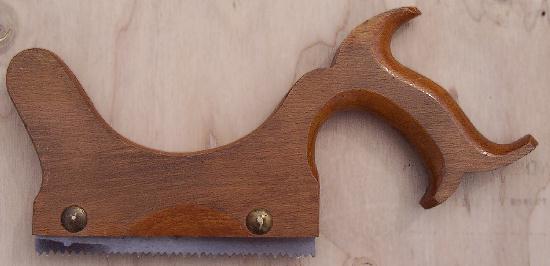
The Disston No. 6 Stair Builders' Saw is used for trenching out stringers, making slots in stair treads or risers, cutting dadoes, etc. Removable blade may be raised or lowered to cut any depth up to 3/4 inch. Blade of Disston Steel with Disston temper, is 6 inches long and 1 5/8 inches wide, toothed 8 points to inch. Hardwood handle, weatherproof finish.
Disston Saw, Tool and File Manual. 1940.
The blade of the No. 1 Pattern Maker's Saw is thin -- (.028). This saw is designed for small, accurate work in pattern and cabinet-making. The teeth are shaped to make a fine, exact cut. 15 points to the inch. Blade of Disston Steel with Disston temper, is 7 1/2 inches long and 1 1/2 inches wide. Open handle, applewood, varnished edges.
Disston Saw, Tool and File Manual. 1940.

The Disston D-18 handsaw was sold briefly in the mid-1920's. The saw was a skewback model featuring a Disstonite handle. What is Disstonite you ask? On this model it was polyoxybenzylmethylenglycolanhydride, more commonly known as bakelite. Ten years later Disston began selling D-95 saws, called "The Masterpiece," made from Tenite, a colorful thermoplastic, which they also marketed as Disstonite. The D-18 was constructed in two pieces held together with four sawnuts through the blade and two more on the horns. The handle shape is comfortable in use. The D-18 appears to have gone the way of other Disston models in the late 1920's, being dropped from the line-up.
Copy taken from a 1925 advertisement:
Here is a new saw that should be in your stock along with the other Disston Saws you are now selling. The new Disstonite Handle, found only on the Disston D-18 Saw, marks another Disston achievement in saw making.
1- The Disstonite Handle is the toughest ever used for saws, Its strength is remarkable. It is practically unbreakable.
2- The Disstonite Handle will not warp, crack nor check. It is not affected by heat cold, or moisture. It cannot change its shape.
3- The Disstonite Handle is always tight on the blade. Every screw is lock-washered. This, and the fact that the Disstonite Handle cannot shrink means that the screws will not come loose.
4- The Disstonite Handle is scientifically fitted to the hand. There was no grain or fibre to be considered in arriving at a shape that gives the greatest comfort and power to the hand. The hand that grips the D-18 can work hours without fatigue.
5- The Disstonite Handle is not affected by water or oil. Excessive heat, cold, rain, perspiration from the hand- none of these affect the new Disstonite Handle.
6- The Disstonite Handle has a beautiful, permanent finish. It polishes to a lustre that is unusually attractive and permanent. The D-18 blade is tempered, ground, and polished by special Disston methods. In combination with the warm brown of the Disstonite Handle, it forms a saw that, because of dominating beauty and utility, attracts everyone.You will want this new saw. Ask your jobber about the Disston D-18.
Henry Disston & Sons, Inc., Philadelphia, U. S. A.
Makers of "The Saw Most Carpenters Use"
The D-19 Flooring Saw was sold from about 1914 until 1955. The handle is adjustable to allow the saw to either crosscut in the usual fashion or be used to start a cut in the middle of a floorboard while it is still down, using the curved side of the blade. The adjustable handle was patented in 1909, and similar hardware was used on "nest of saw" kits, which featured a single handle with numerous blades; plumber's saws; and the No. 14 backsaw. For a short time before the introduction of the D-19 flooring saw, there was a D-18 flooring saw model with a conventional handle and a large, bellied blade that could start a cut in the middle of a situated floorboard. The D-18 appears in the 1911 catalog.


Harvey Peace was a saw manufacturer in Brooklyn, NY from 1863-1890, before they were bought out by Disston to form the National Saw Company. The Harvey Peace model saw, labeled P-26, was featured in the Disston catalog until the WWI era. It featured a cherry, wheat-carved handle with a nickel-plated guard at the base. Harvey Peace saws manufactured before the 1890 acquisition have a medallion with an arm and hammer motif. The Peace saws made by Disston featured a Warrented Superior label screw.


Handy Saw multi-use saw kit, pre-WWII sales literature.


Click on each image to enlarge.
Handy Hand Saw

The Handy Hand Saw was marketed to the "do-it-yourself" homeowner.
Circa 1932.
Polished blade; beech handle, polished; double spray carving; four brass screws, one embossed.
Length
of BladePoint In.
Cross-cutWeight
per doz.Price
per doz.24 inches 8 19 lbs. $20.50

Two You Probably Haven't Seen

Here are two saws from about 1950, and neither one was in a catalog or widely sold. At left is a D-25 Handsaw. What difference is there between this saw and a D-23? Only the etch, apparently. The beechwood handle with dark orange lacquer is the same as found on a D-23 saw from the 1948-1952 time period. Thanks to Todd Foster for this one.
The D-55 Handsaw below has the same features in the handle and hardware as the D-25, so it dates from the same period. There is no mistaking the stainless steel blade with the etch and complete lack of oxidation on the blade.


 [BACK HOME]
