|
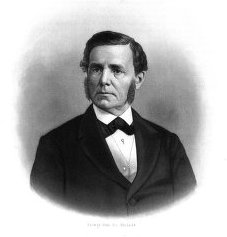
Henry Disston was born in Tewkesbury, England in 1819, the third
child of Thomas and Ann Disston. The story of his father's death
within three days of arriving when the father, Henry, and a sister
emigrated to the States in 1833 has been written in several
biographies, including one by Jacob S. Disston, Jr. reprinted on this website.
Henry Disston served an apprenticeship with the Philadelphia saw
makers William and Charles Johnson, or maybe it was Lindley,
Johnson & Whitcraft as reported in the Jacob S. Disston
biography. This has been researched by Carl Bopp and published in
the Chronicle of the Early American Industries Association
(12/04). Bopp found no evidence of a Lindley, Johnson &
Whitcraft company ever existing.
Disston's apprenticeship ended when his master's company went
bankrupt in 1840. He was compensated with tools and materials in
lieu of cash payment for his work and was freed from his employer
at the age of 21.
During the 1840's Disston operated his business at a series of
rented properties in Philadelphia, including basements,
storefronts, and a private home. One creative man rented Disston
space and left town with the money. What Disston didn't know was
his "landlord" was actually a tenant behind in his rent. The owner
of the building had Disston's shop seized, and its contents become
property of the real landlord.
In 1841, Disston married Amanda Mulvina Bickley. While pregnant
with twins, she fell down stairs in their house on January 1, 1842.
She delivered prematurely, the newborns soon died, and the mother
died on January 7. They were buried in the Mennonite Cemetery in Germantown,
Philadelphia. Disston's first apprentice was David D. Bickley,
his brother-in-law. Bickley worked in the Disstons' factories for 50 years.
Henry Disston remarried in 1843 to Mary Steelman, and they had
five sons survive to adulthood, all of whom went on to be officers in the company.
The saw works had been destroyed by fire in 1849. Despite all
the setbacks Disston suffered thoughout his
company's first decade, the saws were of superior quality, as
evidenced by those saws that survive. By the early 1850's the
Disston company had turned a corner and was well on its way to
being a profitable and leading manufacturer of saws. In 1855,
Disston became the first saw manufacturer to produce his own steel.
This was the factor that made Disston the most successful saw
manufacturer in the U.S. The Morrill Tariff Act of 1861 greatly
increased the cost of imported steel, making it impossible for
other saw makers to compete with Disston.
Disston accumulated huge profits by supplying steel products to
the Union Army during the Civil War. This enabled him to invest in
the factory, mechanizing much of the process of saw and tool
making, lowering cost and increasing production. Some of the
machines used in saw production and the manufacturing of files were
unique to Disston. For over half a century, Disston was the leading
manufacturer of saws in the world. A Time Magazine article claimed in 1940 that 75
percent of the handsaws sold in the U.S. were Disston.
Four of Henry Disston's five sons had management positions in
the factory after completing apprenticeships. The first son,
Hamilton, was an apprentice when he joined the Union Army. When he
returned from the Civil War, he was made a partner in the company.
He took over presidency of the company after Henry's death in 1878.
Albert (1849-1883) had a short life, but his son Frank was company
president 1915-29. Horace (1855-1900) ran the steel mill. William
(1859-1915) was president of Disston and Sons, Inc. after
Hamilton's death in 1896. William's son and grandson also were
company presidents. The youngest son, Jacob (1862-1920), did not
apprentice in the factory; he had a college education and a leading
role in the finances of the company. Jacob's son and grandson were
company presidents as well.
|
 [BACK HOME]

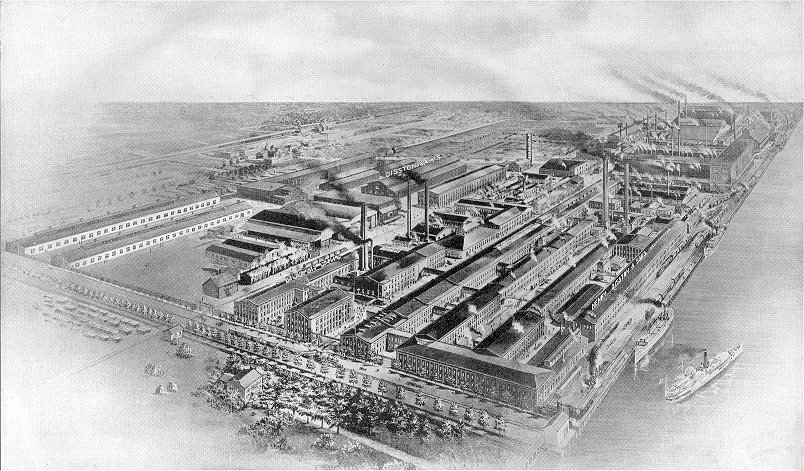
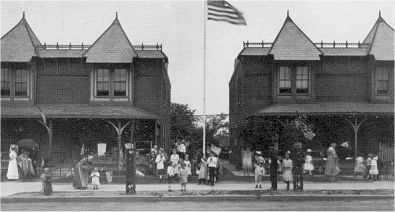 Tacony was a factory "town", actually
located within the Philadelphia city limits. Until Disston moved
in, it had been a sparsely populated area near the Delaware River,
used mostly for summer recreation. In the 1870's Henry Disston
bought large parcels of land in Tacony and set out to build a town
to house his factory and its workers. Compared to the urban squalor
in which many of his employees and their families lived, his
detached single family and duplex houses were working-class
castles. The houses were rented to workers and maintained by
Disston. The trade-off was a straight-laced lifestyle, resulting
from the prohibition of vices and outside influences, which might
distract or reduce the productivity of workers. There were
restrictions on the sorts of businesses that could operate in
Tacony. There were no bars, only tea houses. For a time there were
no other factories in Tacony, so there was no competition for
workers. Livery stables were not allowed near the center of town,
so transportation in and out of Tacony was limited to the trolley,
which was too expensive for most people to use on a regular basis.
Disston employees had no choice but to live in Tacony, so a
lifestyle that groomed and maintained suitable factory workers was
imposed benevolently upon them.
Tacony was a factory "town", actually
located within the Philadelphia city limits. Until Disston moved
in, it had been a sparsely populated area near the Delaware River,
used mostly for summer recreation. In the 1870's Henry Disston
bought large parcels of land in Tacony and set out to build a town
to house his factory and its workers. Compared to the urban squalor
in which many of his employees and their families lived, his
detached single family and duplex houses were working-class
castles. The houses were rented to workers and maintained by
Disston. The trade-off was a straight-laced lifestyle, resulting
from the prohibition of vices and outside influences, which might
distract or reduce the productivity of workers. There were
restrictions on the sorts of businesses that could operate in
Tacony. There were no bars, only tea houses. For a time there were
no other factories in Tacony, so there was no competition for
workers. Livery stables were not allowed near the center of town,
so transportation in and out of Tacony was limited to the trolley,
which was too expensive for most people to use on a regular basis.
Disston employees had no choice but to live in Tacony, so a
lifestyle that groomed and maintained suitable factory workers was
imposed benevolently upon them.
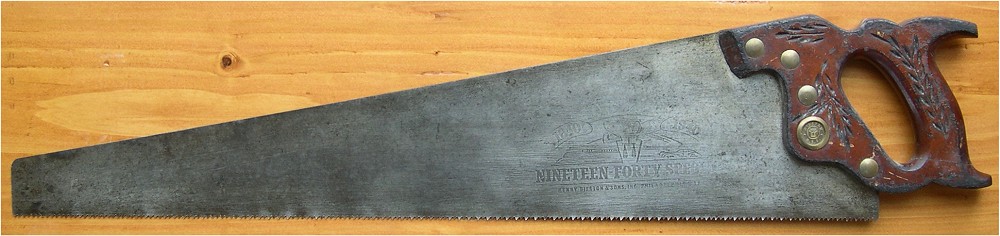
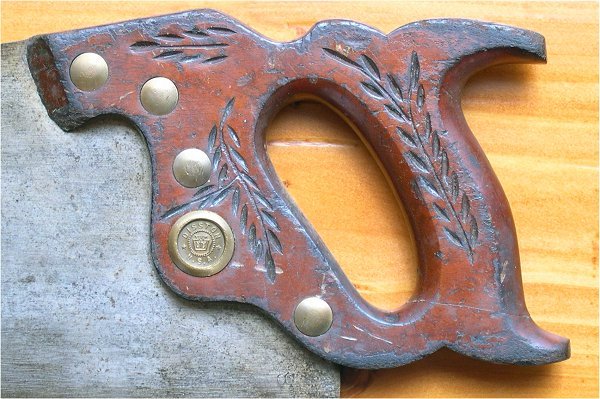
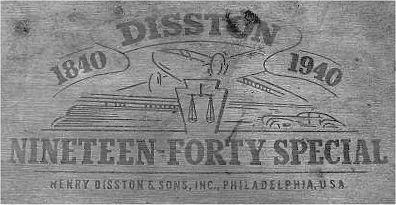 It wouldn't be right to talk about Disston and
not show pictures of a saw. This is the 1940 Special, a
commemorative saw manufactured in conjunction with Disston's
company centennial. The etch is an interesting study in the
phenomenon of streamline design, popular in the U.S. from
1935-1941, originating with the train, the 20th Century Limited.
The handle has a dark orange lacquer finish; the wood
species is an unidentified hardwood, most likely beech. It appears
all 1940 Specials were 26" eight-point crosscut handsaws,
taper-ground.
It wouldn't be right to talk about Disston and
not show pictures of a saw. This is the 1940 Special, a
commemorative saw manufactured in conjunction with Disston's
company centennial. The etch is an interesting study in the
phenomenon of streamline design, popular in the U.S. from
1935-1941, originating with the train, the 20th Century Limited.
The handle has a dark orange lacquer finish; the wood
species is an unidentified hardwood, most likely beech. It appears
all 1940 Specials were 26" eight-point crosscut handsaws,
taper-ground.