UNITED STATES PATENT OFFICE.
HENRY DISSTON, OF PHILADELPHIA, PENNSYLVANIA.
IMPROVEMENT IN HANDSAWS.
Specification forming part of Letters Patent No. 158,921, dated January 19, 1875; application filed
May 14, 1874.
|
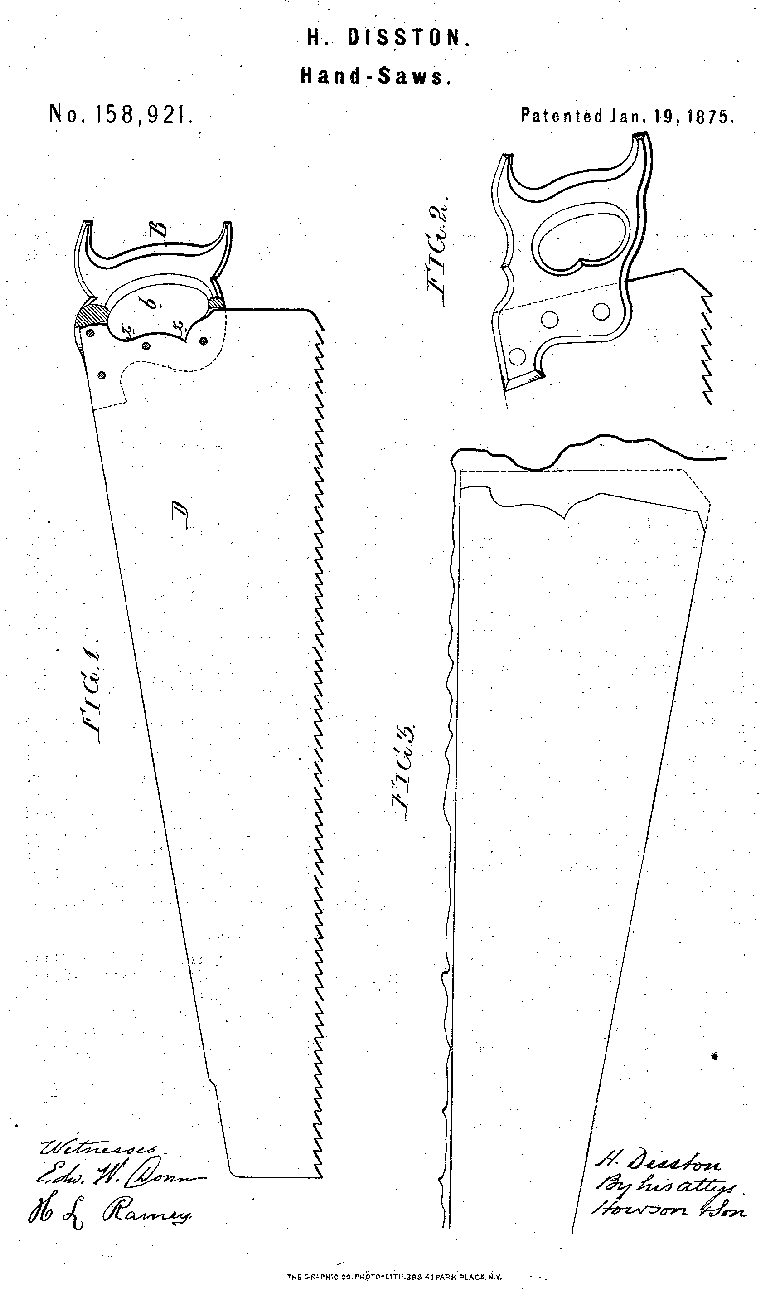
To all whom it may concern: Be it known that I, HENRY DISSTON, of Philadelphia, Pennsylvania, have invented an Improvement in Handsaws, of which the following is a specification: The object of my invention is to construct a handsaw in the manner described hereafter, so that the gripe of the handle will be nearer to the butt of the blade than usual, thereby effecting a saving of steel, and enabling the operator to manipulate the saw with better cutting effect. Figure l is a side view of my improved handsaw, partly in section; Fig. 2, a view of part of an ordinary handsaw, and Fig. 3, a diagram illustrating the saving of steel effected by my invention. In ordinary handsaws the butt of the blade is made straight, as shown in Fig. 2, and the handle is so secured to the blade that the gripe of the former is at a considerable distance from the end of the blade. It Will be evident that the nearer the gripe is to the blade the steadier will be the saw in the hands of the operator, and the more positive and the more free from lateral jars will be the action of the blade; in other words, the nearer the gripe is to the blade the better command will the operator have of the tool. For these reasons I make in the butt of the blade D a recess, x, coinciding with the front edge of the opening b in the handle, and so arranged in respect to the gripe that there is ample room for the fingers of the operator's hand. |
By this arrangement the said gripe B is brought nearer to the butt of the blade, as will be readily understood by a comparison of Fig. l with Fig. 2, the result being not only the advantages referred to above as appertaining to the manipulation of the saw, but a saving of steel is also effected, to the extent shown by the plain and dotted lines in the diagram, Fig. 3, in which the ragged lines show two edges of a crude plate from which the sawblade has to be cut. I wish it to be clearly understood that the strengthening of the handle by the blade is not one of the objects of my invention; nor is this object attained, for the blade does not project far enough into the handle to re-enforce the latter, as will be readily understood by reference to Fig. 1. Hence I do not claim the strengthening of the handle by continuing the blade into the same; nor do I claim, broadly, recessing the butt of the blade, regardless of the position of the recess in respect to the gripe of the handle; but I claim as my invention -- A handsaw in which the butt of the blade has a recess, x, coinciding with the front edge of the opening b in the handle, and arranged in respect to the gripe B as set forth. In testimony whereof I have signed my name to this specification in the presence of two subscribing witnesses. HENRY DISSTON. Witnesses: |
|
 [BACK HOME]
